About Us
Change making
Whether you are new to desiring social change and justice, or a lifelong organizer, we’d love to be in community with you. We’d like to meet and build relationships with people who have a genuine desire for root level change; going beyond personal growth to include relationships of solidarity and resource redistribution.
Vision
Rooted in friendship, SpitFire Press creates welcoming, supportive, and conversational pamphlets that aim to create a more just and caring world.
Join us
Our pamphlets amplify the work of people who inspire and challenge us while building a network of readers who are listening (grounded in curiosity and care) and taking action (in small and/or big ways).
Old School
Inspired by White Rose
We wanted SpitFire to be tangible and analog. Something people could pass on to their friends and family or sit with while cozy.
Tina wanted to create something tactile, beautiful, and interesting, something that was different in the way you engage with it – she wanted to play with design and see if the act of doing something different with your hands opened you up to something different in your mind and body.
Political art and graffiti has long delighted and inspired Jeanette. When Tina brought up the idea of creating a publication Jeanette loved the idea of continuing the work of resistance movements that used pamphlets and small print editions as a tool for collective change. Among the many inspirations is the White Rose resistance group in Nazi Germany who produced leaflets and conducted a graffiti campaign that called for active opposition to the Nazi regime. The willingness to speak honestly about the systems of power and violence we live within, in a way that welcomes others to learn and join in, feels powerful, important, and relevant today.
Both of us wanted to create something digestible, conversational, and relatable. Something that shared information and supported people to feel courageous so they could speak out and take action against systems of violence and oppression.
Volumes 1 + 2
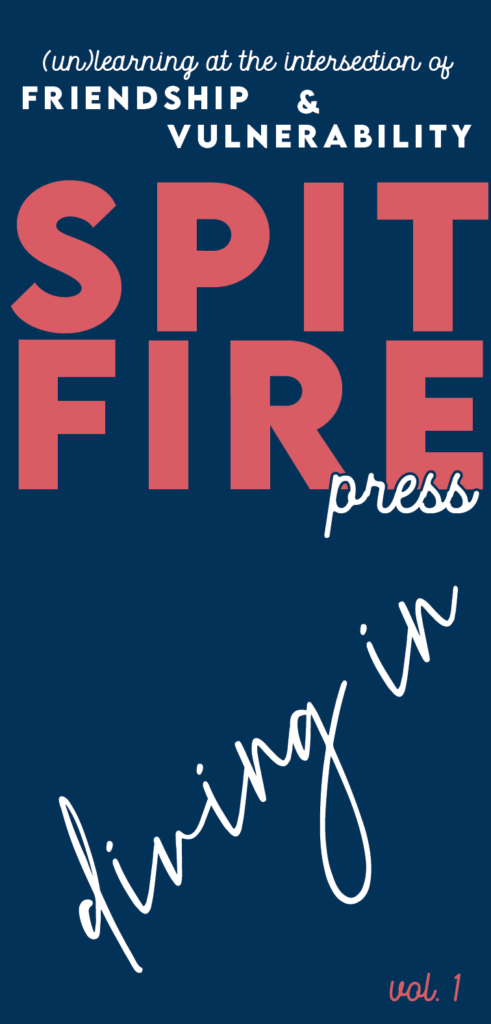
Our first two volumes focus on white supremacy culture and aim to create practice space where readers can work on undoing white supremacy culture (WSC) within ourselves and identify it in the world around us. Volume 1 focuses on urgency while Volume 2 reflects on denial, defensiveness, and perfectionism.
What we’ve learned from our own practice of unlearning is that it’s easiest to face internalized whiteness when we don’t feel alone, when we can see whiteness as part of a broader systems that purposefully teach us these world views, and that these thoughts and behaviours aren’t personal failings – but that they are our responsibility to unlearn, undo, and dismantle.
Our deepest unlearning has come when we root in vulnerability and friendship, supporting us so we don’t sink into shame or guilt, but rather move toward action and tenaciously trying; whether it be through listening, learning, and self reflection, or practicing solidarity guided by the people most impacted, making art, hosting events, the possibilities are endless and all are needed.
One of our key bits of learning is that mistakes are part of the process. They are the result of learning in action and we can’t avoid them. What matters is that we make amends and keep on trying. So with that in mind, if you see us making mistakes please let us know. We ask that you give us feedback rooted in a collective desire for growth, friendship, and vulnerability and that you give us the grace of allowing us to make mistakes and try again. We will listen and reflect and maybe/likely contend with defensiveness and denial because they are a WSC characteristic we’re unlearning. We’d like to include feedback and lessons we’ve learned in each edition. If you would like to share your experiences please email us at spitfirepress.contact@gmail.com or fill out the contact form here.
Volume 1: Published November 2023
Volume 2: Published February 2025
Forthcoming
Volume 3
Volume 3 asks the question “What is violence and who defines it?” and is being made in response to a request from Indigenous land defenders for settlers to learn about – and speak honestly about – state violence.
This volume will look at various aspects of state level violence including:
- What is settler colonialism
- What is violence and who defines it
- The history and current function of the RCMP / police
- What are dog whistles
- Power: what is it and how does it work
- And more from people we are inspired by and want to hear their thoughts about kinds of violence
We’re going to start reaching out to contributors soon. If you know of someone who we should consider working with please email us at spitfirepress.contact@gmail.com or fill out the contact form here.
Jeanette works and takes care of her beloved partner who has a disability and Tina is taking care of our newest family member baby B, so our timeline on getting volume 3 done is unknown. We’re taking things one step at a time. If there is a lot of interest in Volumes 1 + 2, and folks ask for Volume 3, we’ll follow the energy. If you like our work and want to see a third edition let us know.
What is Empire?
Have you heard people say ‘Empire’ but you don’t know what it means? We’ve got you <3
Empire means a few things:
1) Empire can mean a country, but in particular a country that uses military force or economic coercion (using threats or violence to get your way) to bully other countries. Sometimes Empires take over other countries completely or get them to do what they want by force. They do this to expand their power and control – often to take their resources (forests/trees, oil, gas, minerals, people they can force to work for low wages). This is process of using force is called Imperialism and the process of taking over countries completely is called colonization.
2) Empire can also mean the violence and oppression (injustice / inequality) that results from Imperialism and colonization (#1). Empire and ruling classes need to use violence to stay in power (because people didn’t chose them). So violence and oppression are built into systems (laws, policies), structures (education system, court system), and institutions (school, courts, hospitals). For example, violence and oppression are part of capitalism. Instead of everyone having what we need to live good and thriving lives, Empire created and enforced one built on greed and hoarding. Capitalism benefits a few (billionaires/ruling classes/owning classes) and harms the rest of us. There are a lot of examples of violence and oppression that are used by Empires to stay in power. They are all important and a few are listed below. These are complex ideas, that I can explain if you want, but not right now because I’m hungry 🙂 Here’s a short list: the ‘carceral state’ (meaning a country that uses prisons and police to control and punish people – but mostly radicalized people and poor and working class people), white supremacy culture, racism, heterosexism, ableism, eugenics, misogyny, whorephobia, transphobia, fatphobia, rape culture, kid oppression, and more.
Empires are kept in power by organizations (like the police, RCMP, prisons, the World Bank, International Monetary Fund, World Trade Organization, etc) and concepts (like productivity, scarcity, urgency, and more) and people, like us (when we tell people not to rock the boat, get defensiveness when someone tells us we did something racist, when replay devils advocate or talk about ‘both sides’, and many many more). Over time we will look at this in more detail, but for now this is a good place to start.